Cinema and associated industries in Waterloo
You could argue that the centre of the cinema experience in London today, even England, is at Waterloo with the British Film Institute (BFI) and the imposing IMAX Cinema. But what are the area’s previous links with the then new and up and coming entertainment of the 1900s?
Cinema made its first appearance in London in 1896 at the Polytechnic in Upper Regent Street. According to www.cinematreasures.org two years later Carlo Gatti was showing films as a part of the music hall entertainment at his theatre ‘over the river’ in Westminster Bridge Road.
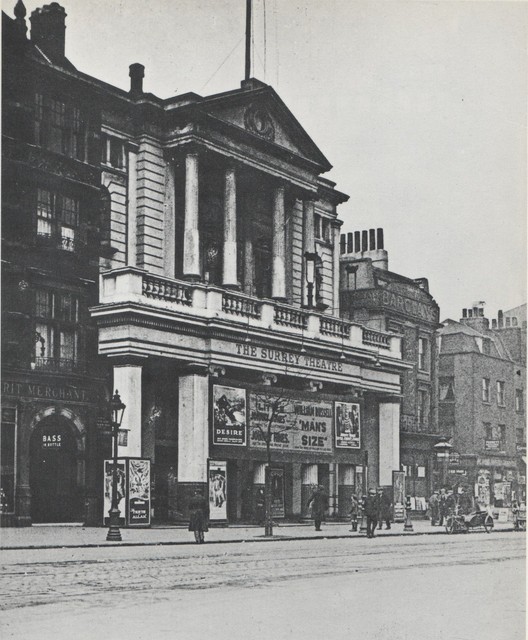
The Waterloo Local History Society’s geographical area had 13 locations designated as places showing films before the outbreak of the First World War in 1914. Four were theatres/music halls: Gatti’s and The Canterbury in Westminster Bridge Road, The Royal Victoria (now the Old Vic) in Waterloo Road and the Surrey Theatre in Blackfriars Road near the Obelisk.; It should be noted that all were situated on key tramways and/ roads linking south of the river over bridges to the north. These palaces of entertainment accommodated large numbers of people, had facilities for eating and drinking and staff to manage the crowds. It was therefore an obvious path to take, to rearrange the space to accommodate a cinematograph apparatus ‘box’ with a projector to show the films.
These boxes however were highly flammable and dangerous. This safety issue became the responsibility of the London County Council who issued licences to owners to permit h such equipment, and it was the duty of the London Fire Brigade to inspect and monitor them. It is from these records held by the London Fire Brigade and the Licence applications to the LCC that Tony Fletcher used to record the other cinemas which were either public halls or shop premises. These halls were used for a variety of purposes, not just for film shows, such as boxing at the Ring in Blackfriars Road seating a 1000. But for the Waterloo area the majority of the halls were attached or close to places of worship: St George’s Hall, annexed to St George’s Catholic Cathedral; Hawkstone Hall a part of Christ Church Congregational Mission in Kennington Road and, what was to become the Ideal Cinema, the hall attached to the Wesleyan Mission in Lambeth Road. The Wesleyan Mission provided showings specifically for children between 7.00 and 9.00 in the evening with a cup of tea too.
The remaining group of film screening providers occupied or converted shop premises, such as in Lower Marsh with the Cosy Cinema seating 400 at number 44-45 and the Imperial Bioscope at number 101. Eastwards in the New Cut at number 17 there was the Anglo American Bioscope, seating 120 with an entrance fee of 1d. What seems to have been of larger capacity were premises known as the Picture Theatre also known as or the Electric Theatre, or the Grand Central Cinema or, location specific, the Blackfriars Grand Cinematograph at no.54-55 Blackfriars Road towards the river. Prior to 1909 the premises belonged to Cycledom Limited cycle makers with Wholesale Cycle Trade Supply Co.Ltd at no 52 and 53. (Whether the two properties came up for a new lease but from by 1910, according to Tony Fletcher, the Cinematograph had been enlarged to incorporate these two properties but the capacity is unclear.)
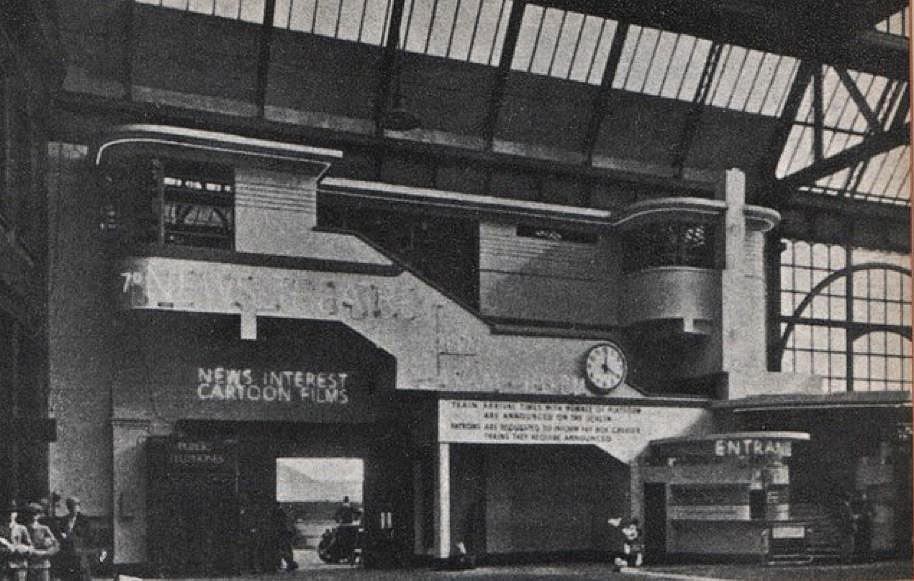
All the above mentioned cinematograph locations were in existence between 1898 and 1914 with a number of these continuing to show films up until the Second World War. There was only one purpose built cinema in the locality and that was the News Cinema off Platform 1 on Waterloo station concourse which ran for 36 years from 1934 to 1970, with its prime audience probably being commuters rather than locals. However local residents had many other opportunities to enjoy seeing a film. Many cinemas were located in London Road, south of the Obelisk and around the area of Elephant and Castle and of course the West End, Leicester Square, the commercial centre of film promotion, just a tram/underground stop away.
To keep us up to date the area has lost all the above mentioned cinemas but has gained 4 screens within the BFI complex, The Imax and the Curzon chain’s venue at Sea Containers Hotel east of the OXO Tower.
In terms of associated local industries or businesses such as cinematic equipment or advertising, there are a few references in the trade directories with Westminster Bridge Road being the main focus: Cash Film Hire Exchange (dealers)at 107, Jones and Co. Screen Manufacturers and Suppliers at 113 and J. Walter Cinematic Equipment Manufacturer and Seating Supplier at number 181. In Lower Marsh The National Film Manufacturing Company offered Film Services including posters, advertising and producers according to the Kinematograph Year Book of 1915. But it is noted that these have disappeared by 1918 probably migrating north to the neighbourhood of Dean Street, the homeland of production and distribution or closed down due to the impact of the War.
It is tempting to make the assumption that, like the Victorian theatres and music halls quickly being converting to showing film, local tradesmen and women adjusted their skills and products to support the new entertainment. We can see listed in the Kinematograph Year Book costumiers H & M Raine in Waterloo Road, but there is no evidence as yet that the clients of Theatre/ Variety agents Felice Napoli and Co., again in Waterloo Road were in the film industry.
Sources
The three main sources for the listing of these institutions are: The Post Office/Kelly Directories which allow the researcher to locate the place using the street directory and to confirm by using the professional traders entries. Secondly is the research carried out by Tony Fletcher in his three volumes on the records of the London Fire Brigade which annotated the visits to buildings housing film equipment to ensure all fire safety regulations were in place. The earliest records are for 1907. The third are the Bioscope Annual Directories and the Kinematograph Year Books, found at the Reuben Library BFI, for the new and burgeoning industry with names and addresses of all the industries associated with filmmaking and cinema.
A Kinematographic Journey through London 1907-8 by Tony Fletcher 2013 Local History Publications
Regulating the Cinematograph in London 1897 -1906 by Tony Fletcher 2017 Local History Publications
The Kinematograph Theatre Arrives 1909 by Tony Fletcher 2020 Local History Publications