Apollo Gardens
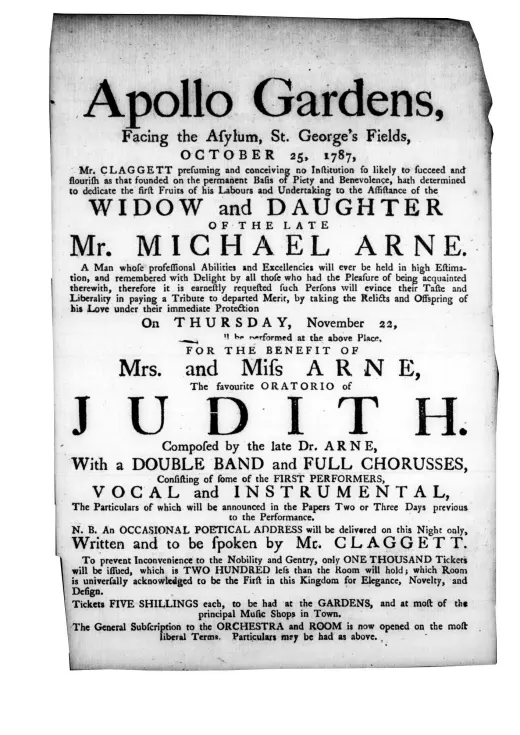
This pleasure garden was situated approximately where Pearman Street now is. It was established by Crispus Claggett who later went on to run the Pantheon Entertainment Hall in Oxford Street. Initially there was only a “Great Room” or Assembly Room where the first concerts were given in the autumn of 1787.
Cinema made its first appearance in London in 1896 at the Polytechnic in Upper Regent Street. According to www.cinematreasures.org two years later Carlo Gatti was showing films as a part of the music hall entertainment at his theatre ‘over the river’ in Westminster Bridge Road.
The Waterloo Local History Society’s geographical area had 13 locations designated as places showing films before the outbreak of the First World War in 1914. Four were theatres/music halls: Gatti’s and The Canterbury in Westminster Bridge Road, The Royal Victoria (now the Old Vic) in Waterloo Road and the Surrey Theatre in Blackfriars Road near the Obelisk.; It should be noted that all were situated on key tramways and/ roads linking south of the river over bridges to the north. These palaces of entertainment accommodated large numbers of people, had facilities for eating and drinking and staff to manage the crowds. It was therefore an obvious path to take, to rearrange the space to accommodate a cinematograph apparatus ‘box’ with a projector to show the films.
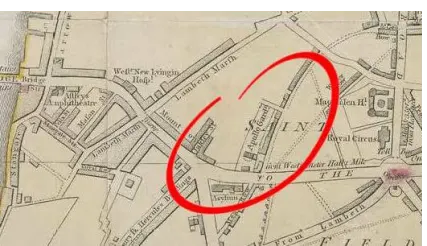
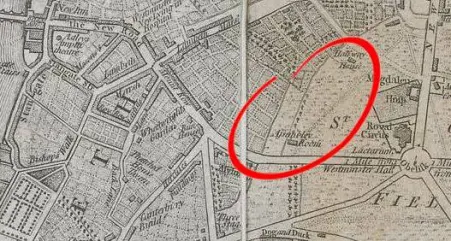
Sadly there are no illustrations of how the garden appeared so one has to rely on written descriptions and what one can make out from maps.
…the concert room, which is described as a fine building with “ a kind of orrery (a model of the solar system) in the dome, displaying a pallid moon between two brilliant transparencies.'' ln this building was an orchestra containing a fine-toned organ...
... ln the gardens were a number of “ elegant pavilions or alcoves” ornamented with the adventures of Don Quixote and other paintings.
“The gardens were illuminated, sometimes with two thousand lamps."
At a later date “unparalled TRANSPARENCY of his MAJESTY and FAMILY” was on display.
According to its advertisements the gardens were being regularly improved and becoming ever more magnificent. By 1792 the so-called Grand Apollonian Promenade had been added and become part of the resort’s title. But it would appear also that parts of the site were being developed for housing presumably as a source of finance.
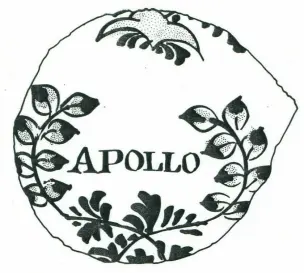
The focus of the entertainment was music but Crispus Claggett did not obtain his music license until about 1790. So at the beginning he had to make a ticketing arrangement where entry was controlled by the issuing of Tea vouchers which could be charged for. Money could also be made by selling food and wine which the proprietor insisted were of the finest quality. The food was certainly served on distinctive dishes one of which was uncovered during archaeological investigations in Pearman Street during the 1970s.
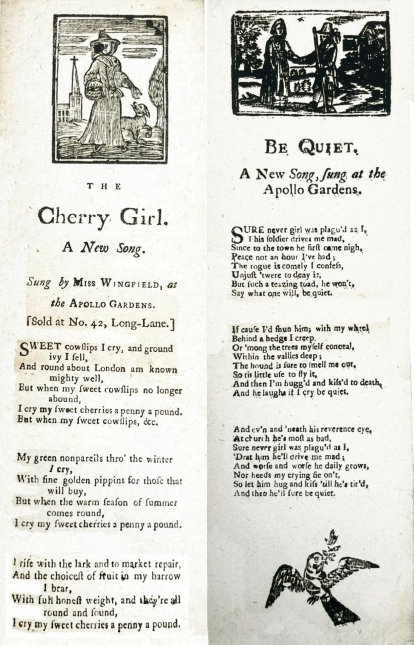
Although both vocal and instrumental music was advertised it appears it was mostly popular ballads that were performed. Many of the artists would have sung at the various pleasure gardens in turn but there were some songs that were seemingly special to the Apollo Gardens
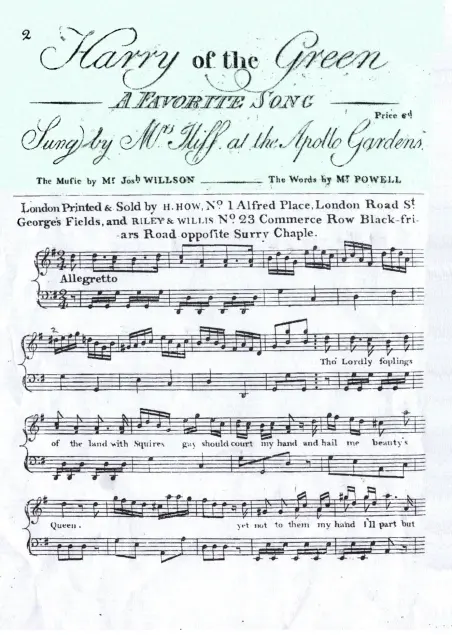
Most of the songs that one can find in the archives only have the words. But there are some complete with music. Interestingly this song was printed and sold very nearby to the Gardens.
Despite the “improvements” and the “quality” of the music and wine, the Gardens failed to attract the better sorts. Mr Claggett claimed the patronage of the nobility and gentry and boasted of the “Chastity and Dignity” of the place. But it actually acquired a reputation as the haunt of “cheats and pickpockets”
It was observed by commentators that:
“A want of the rural accompaniment of fine trees, their small extent, their situation, and other causes, soon made the Gardens the resort of only low and vicious characters"
I don’t think circumstances were helped by building developments that started eating into the area of the Gardens
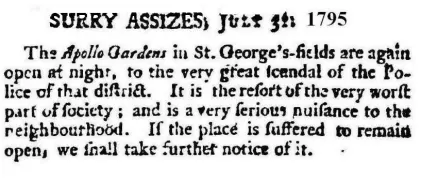
By 1795 the reputation of the Gardens was such that legal action was being considered. There is a rumour however that the magistrates who threatened the enterprise were indebted to the owners of the Vauxhall gardens or other local pleasure gardens.
It is said that Crispus Claggett was declared bankrupt in 1795 but somehow he managed to take over the Pantheon in Oxford Street at that date.
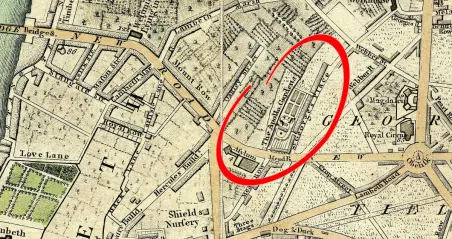
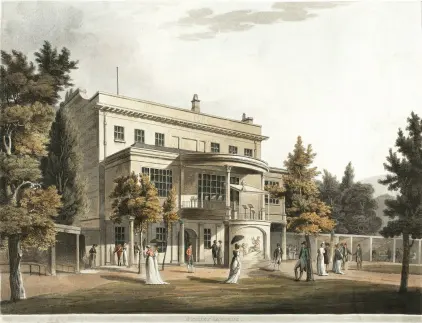
According to Walford’s London Recollected the orchestra building was taken down and re erected at Sydney Gardens in Bath. It is just about plausible date-wise and the oblong building of three bays long with its semi-circular projection could fit the map of 1790. So does this give a tantalising impression of how Apollo Gardens looked?
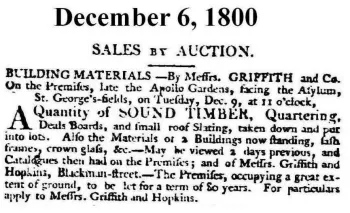
What was left of the Gardens was auctioned off in 1800. Already in 1799 Horwood’s map shows part of the gardens built on with small closely packed houses called Apollo Buildings. The rest of the gardens were then built on with two narrow streets, Hooper Street and Jurston Street and these in turn were replaced with Pearman Street in 1884. This used to be a very hard urban street but fairly recently it has been softened with trees, climbers and planting beds and is beginning to have the feel of a garden again.